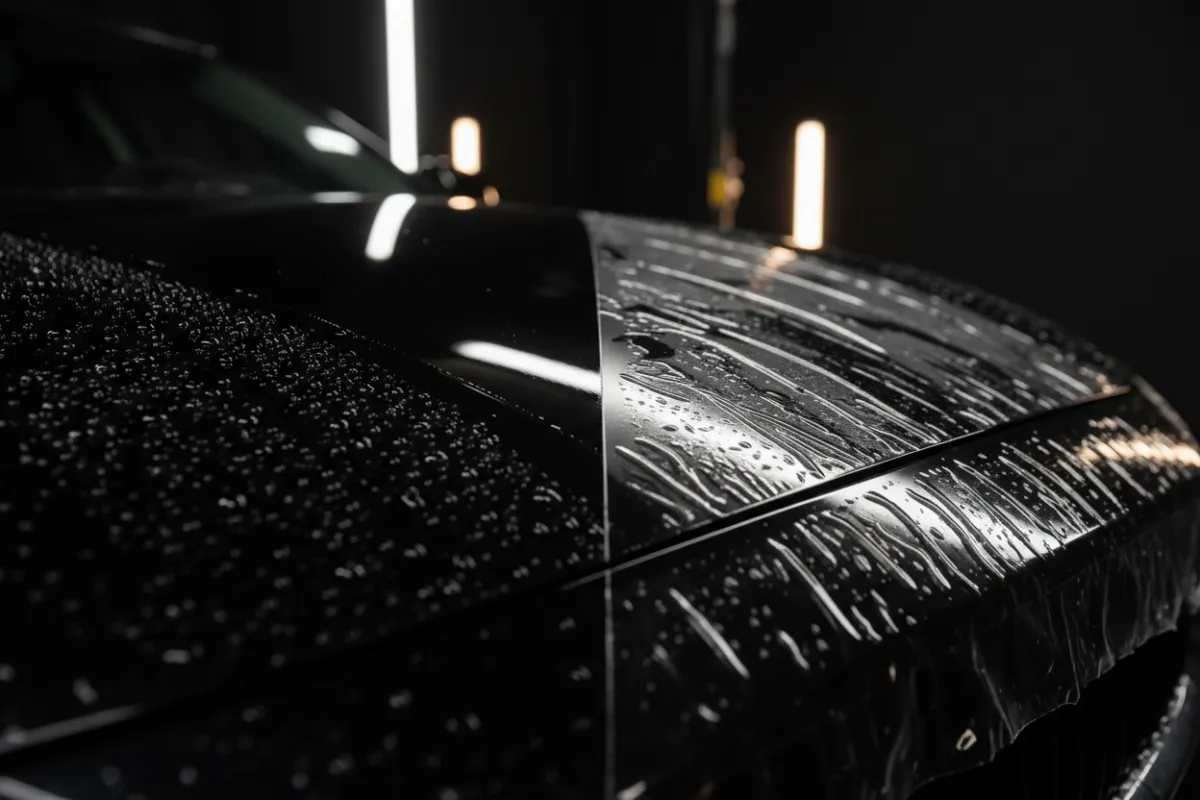
When people ask us whether they need ceramic coating or paint protection film, they're usually assuming the two products compete for the same job. They don't. Ceramic coating is a chemical shield — it changes how the surface of your paint reacts to salt, UV, and grime. Paint protection film is a physical shield — a clear urethane layer that sits over the clear coat and absorbs impact damage. One doesn't replace the other. They solve two different problems that both show up hard on a Scarborough daily driver.
What Ceramic Coating Actually Protects Against
Ceramic coating is a liquid polymer, mostly silicon dioxide, that bonds to your clear coat and cures into a hard, transparent layer. Once cured, it changes how the paint behaves:
What it does not do is stop a stone off the 401 from chipping your hood. Multi-layer ceramic coatings measure around 9H on the pencil hardness scale, which resists light abrasion — fine wash marring, light swirls — but a rock at highway speed chips through a ceramic coating exactly as easily as it chips bare paint. We cover the full mechanics of how the coating bonds and cures, including the paint correction step that has to happen first, on our ceramic coating page.
What Paint Protection Film Actually Protects Against
PPF is a different category of product entirely. It's a clear, several-mil-thick urethane film installed directly onto the painted surface — front bumper, hood, fenders, mirrors, or the whole car, depending on the coverage level. Because it's a physical layer rather than a chemical bond, it:
PPF does not stop chemical etching from bird droppings or UV fading on panels it doesn't cover, and it doesn't make washing meaningfully easier the way ceramic coating does. It's a shield against impact, not against chemistry. We install XPEL and Legend Films at our Scarborough studio — more on coverage options on our paint protection film page.
Ceramic Coating vs. PPF, at a Glance
Ceramic Coating
Paint Protection Film
Can You Get Both? Yes — and the Order Matters
PPF and ceramic coating are commonly installed together, and the sequence isn't arbitrary. Film goes on first, directly onto bare, corrected paint. Ceramic coating goes on top of the film. That order gives the film UV resistance it doesn't have on its own, makes it easier to keep clean, and lets the hydrophobic surface behave the same whether you're looking at a filmed panel or a coated one. Installing it the other way — filming over an already-coated panel — is unusual and not how we sequence jobs at our studio.
How to Decide: Three Scarborough Driving Profiles
You commute the 401, DVP, or 404 daily
Gravel and stone chips off other vehicles' tires are the dominant threat on your hood, front bumper, and mirrors. Partial front PPF is usually the highest-leverage first purchase for a highway commuter — it's the coverage most directly aimed at the damage you're actually accumulating.
Your car sits street-parked or in an uncovered driveway
Salt brine in winter, bird droppings and tree sap in summer, and constant UV exposure are the bigger risk for a car that lives outside. Ceramic coating's chemical resistance is the priority here — it's what actually fights the etching and fading that outdoor parking accelerates.
You're keeping the car for years and want the least long-term maintenance
This is where doing both pays off. PPF on the high-impact zones — front bumper, hood, mirrors, front fenders — combined with ceramic coating over the entire vehicle layers physical and chemical protection together instead of forcing a choice between them.
Myths We Hear at the Studio
Book a Free Assessment
The honest answer for most Scarborough drivers is that the right choice depends on how and where you drive, not a universal rule. Bring the car into our Finchdene studio and we'll look at the paint, talk through your driving pattern and budget, and recommend ceramic coating, PPF, or both — with a written quote before anything touches the car. Many clients pair either service with a full auto detail beforehand so the surface is clean and assessed properly. Call (647) 689-6109 or request a quote through our contact page to book.
Should PPF go on before or after ceramic coating?
Film goes on first, directly onto bare, corrected paint. Ceramic coating is then applied over the film. This order gives the film UV resistance it doesn't have on its own and makes it easier to keep clean. Installing it the other way — filming over an already-coated panel — is unusual and not how we sequence installs.
Which one protects better against Scarborough's road salt?
Ceramic coating. Salt and brine are chemical, not physical, threats — they etch bare clear coat over a winter of exposure. PPF resists the same salt just as well on the panels it covers, but it's typically installed only on high-impact zones like the front bumper, hood, and fenders, leaving the rest of the car unprotected from chemical staining unless it's also ceramic coated.
Do I need paint correction before PPF the same way I do before ceramic coating?
Yes, for the same reason. Film applied over swirl marks and light scratches locks those imperfections in underneath a layer that's difficult to remove without risking the paint. We recommend at minimum a full decontamination and, for anything beyond light wear, a single-stage correction before film goes on.
How much does it cost to do both PPF and ceramic coating?
Ceramic coating starts at $599 for our 2-year single-stage package. PPF is priced separately based on coverage area and vehicle size — we don't post a fixed PPF price because a partial front on a compact sedan and a full-body wrap on a three-row SUV are different jobs. Book a free consultation and we'll quote both together. For the numbers, see our ceramic coating cost guide and our PPF pricing guide for Toronto.
Which one should I get on a leased vehicle?
PPF on the high-impact zones — front bumper, hood, mirrors — is usually the better lease play. It prevents the stone-chip damage that shows up on a lease-end inspection report, and it comes off without touching the factory paint. Ceramic coating is still worth adding if you're keeping the car through the full lease term and want easier washing with less risk of swirl marks from regular car washes.
