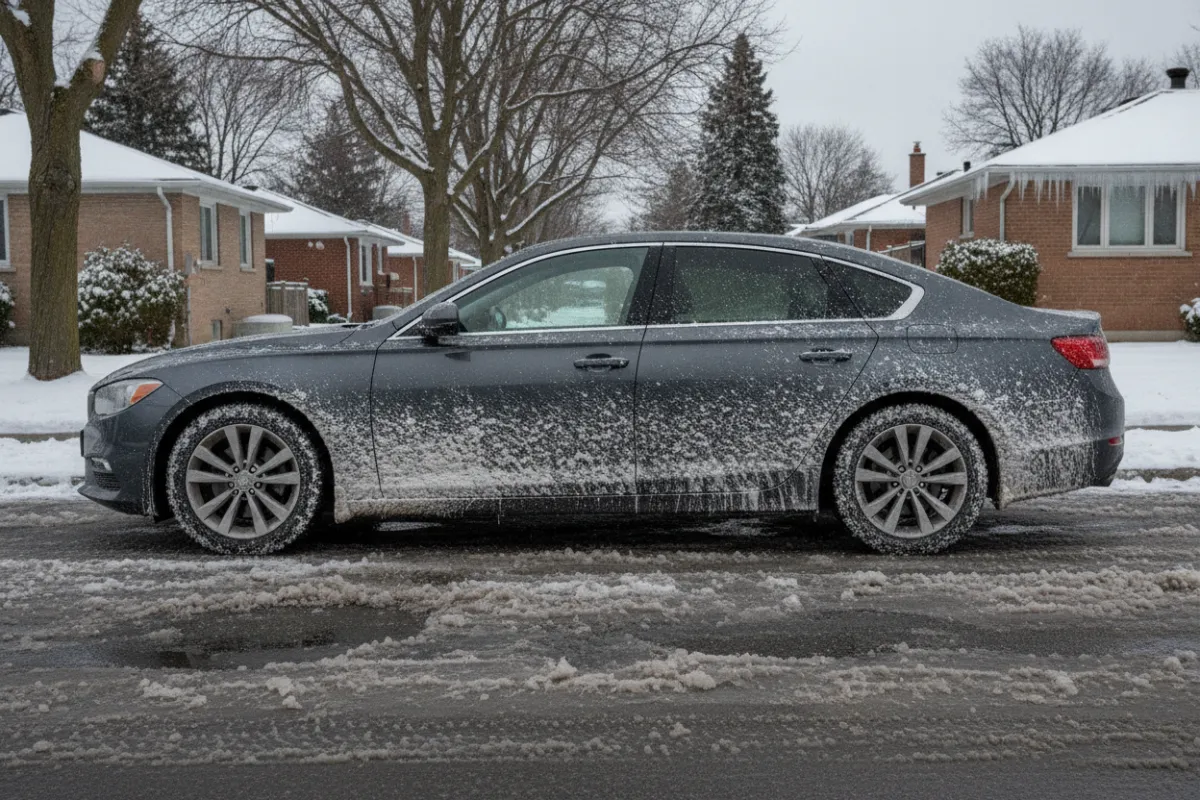
By the first week of May, every car that drove through a Toronto winter has the same five problems. White salt rings on the lower doors. A film of fine grit on the windshield no one can wipe off. A chalky haze on the front bumper. Carpet that's still damp at the heel. And brake-dust streaks down the wheels that the touchless wash didn't touch. This post explains where each of those came from, and the order we work through them on a typical post-winter recovery detail.
Why Ontario salt is harsher than most
Toronto and the GTA run a brine-pre-wet salt program. Calcium chloride is sprayed in advance of storms; rock salt and sand follow once snow lands. The result is six months — November through April — of mixed-chloride spray on every road surface. Highway 401, Highway 404, the DVP, and the QEW are particularly aggressive because the salt application rate scales with traffic volume. A daily commuter driving the 401 between Scarborough and downtown is collecting a fresh chemical layer on the front fascia and lower body panels almost every weekday from December through March.
Compare that with most US Sun Belt cities — Atlanta, Phoenix, Houston — where road salt is rare or nonexistent. Cars in those climates simply don't see this kind of chloride exposure. It's why ceramic coating sells more aggressively in Toronto and Montreal than in southern markets — the chemical-resistance value proposition is genuinely larger here.
The five things winter does to your car
1. Salt rings on lower body panels
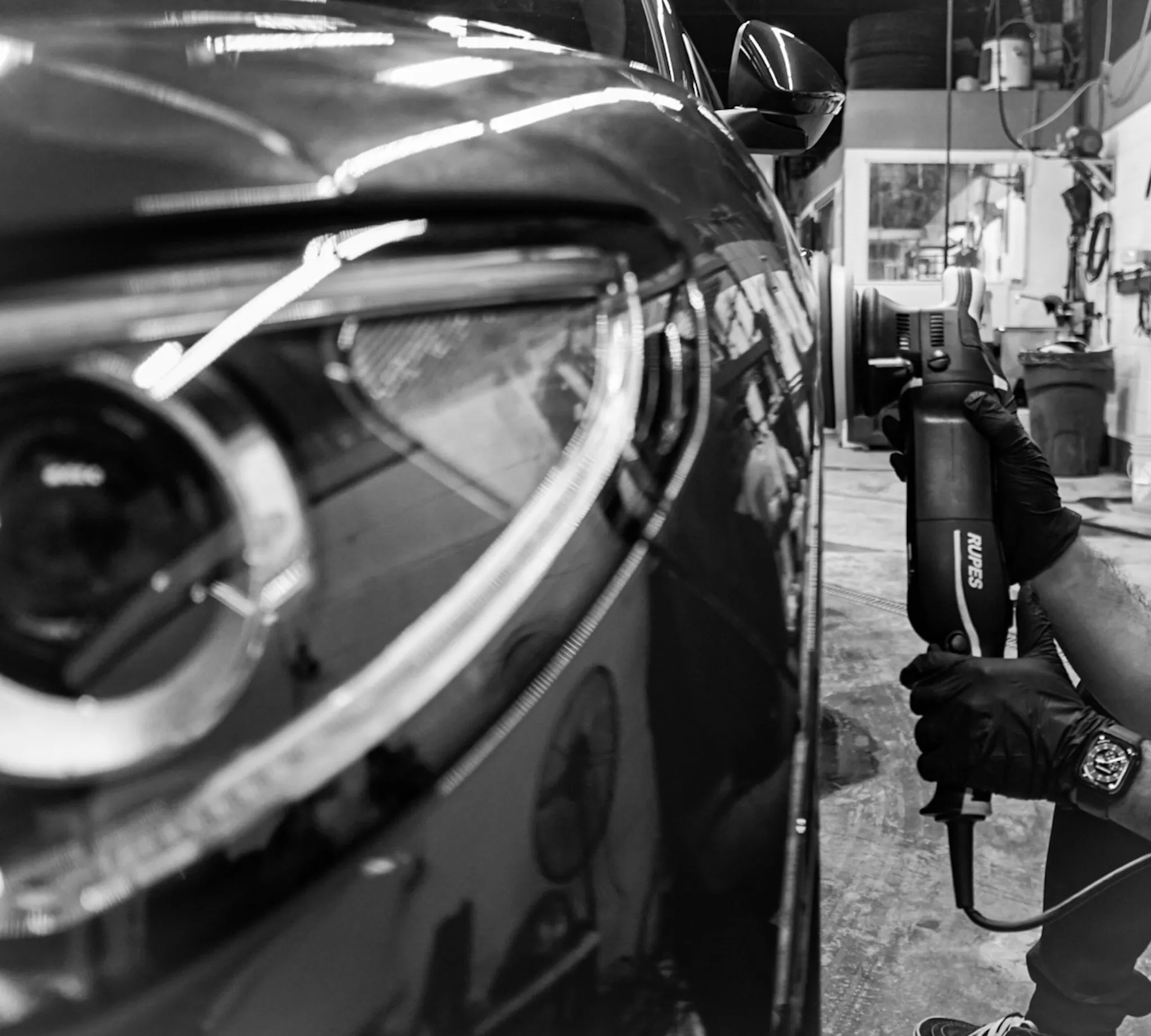
That white crust isn't dirt — it's evaporated brine that has crystallized on the paint. Left untreated, the chloride continues to react with the clear coat and any exposed metal at panel edges, accelerating both micro-corrosion and clear-coat etching. The cure is a multi-stage decontamination wash: foam pre-soak to soften the salt, two-bucket hand wash with pH-neutral soap, iron-fallout remover (Iron-X or CarPro IronX) to lift bonded ferrous particles, then a clay bar to pull anything still embedded in the paint. Salt rings come off cleanly when treated within the first 6–8 weeks of spring. Treat it later than that and you're often looking at light paint correction to remove the etched halo the brine left behind.
2. Stone-chip damage on the front fascia
Winter road salt is mixed with sand and aggregate to add traction. That sand becomes airborne behind every vehicle ahead of you on the 401. Front bumpers, hoods, mirror caps, and rocker panels collect dozens of small chips every winter — usually invisible until paint correction reveals them under inspection lighting. The fix tier depends on the depth: light surface chips polish out; chips through the colour coat to primer need touch-up paint; chips to bare metal need professional respray. We assess every front-end with a paint-thickness gauge before quoting correction, so you only pay for the work the paint actually needs.
3. Brake-dust baked onto wheels and lower panels
Stop-and-go winter traffic produces more brake dust than summer driving — every red light is a friction event. Brake dust is iron-rich, hot when it lands on a wheel, and bonds molecularly to clear coat over the season. Touchless car-wash chemistry doesn't shift it. The fix is a dedicated wheel cleaner like Sonax Full Effect or CG Diablo, contact agitation with a dedicated wheel mitt, and a follow-up iron-fallout treatment on any panels where the dust splashed up — usually rocker panels, lower fenders, and the rear bumper above the exhaust.
4. Salt and sand in the carpet, door sills, and trunk
Every time you got out of the car wearing winter boots, you tracked salt brine and grit into the carpet. By April that material has worked into the carpet padding under the floor mats. Vacuuming alone won't remove it — the salt has dissolved into the underlying fibres. The fix is hot-water extraction at 200°F (truck-mounted Mytee unit), which liquefies the chloride and pulls it back out, followed by a dehumidified dry-out in the bay. Heel cup at the driver's seat usually needs two passes; trunk carpets typically need one. We also pull the cargo liner where possible to flush the area underneath, where salt collects from groceries, hockey bags, and Costco runs. A full interior detail with extraction takes 3–4 hours on a sedan and is the most-requested service we run from mid-March through end of May.
5. Windshield + glass mineral haze
That fine film on your windshield that streaks no matter what cleaner you use is calcium and magnesium deposits from brine spray plus winter washer fluid. The deposits sit in the microscopic pits of weathered glass. The fix is a glass-restoration polish (CarPro CeriGlass or 3M 60150), applied with a soft pad on a low-RPM polisher, followed by a hydrophobic glass coating like Gtechniq G1 ClearVision. The result lasts 4–6 months and dramatically improves wet-weather visibility — you stop fighting the streaks the rest of the year.
Our typical post-winter recovery process
On a typical post-winter sedan or SUV, the recovery work runs in this order, taking 5–7 hours total: (1) foam pre-soak + two-bucket hand wash; (2) iron-fallout treatment + clay bar decontamination on all painted surfaces; (3) wheel deep-clean and wheel-arch flush to remove undercarriage salt; (4) interior steam + hot-water extraction on all carpets and floor mats; (5) glass polish + hydrophobic seal; (6) sealant or ceramic top-up if the car is already coated. Total cost typically lands $249–$399 for a sedan, $299–$499 for an SUV. Heavy salt-line cars or those with deep brake-dust adhesion add $50–$100 for the additional decontamination time. Book online or call (647) 689-6109 from our contact page — most days we can take a drop-off the next morning.
Preventing it next winter
If you don't want to repeat this same recovery sweep next May, four things measurably reduce winter damage. First — get a ceramic coating before next November. The hydrophobic surface lets salt brine sheet off rather than dry into the paint, and the chemical resistance prevents the slow clear-coat etching brine causes on uncoated cars. Second — wash every 3–4 weeks during salt season, even if it's cold and inconvenient. Touchless is fine; the goal is to flush the chloride before it crystallizes. Third — replace your windshield washer fluid before November with a winter-grade methanol blend so you're not reapplying mineral haze every wipe. Fourth — undercoat or rust-proof the chassis, especially if your car is older than 5 years. We're adding undercoating to our service menu in the second half of 2026 specifically because of how much winter damage we see at this time of year on otherwise-clean GTA daily drivers.
Bottom line
Spring detail bookings are heavy through May, and the carpet/extraction equipment is fully booked most weekends. If you're reading this in early-to-mid May, book within the next 7–14 days to catch us before the queue gets longer. Drop the car off at our 170 Finchdene Square studio in Scarborough — most full-recovery details turn around inside business hours, and we'll text you photos before/after so you can see what came off. For pricing on specific packages see our auto detailing service page, or call (647) 689-6109 to book.